
Boundries
What Are Boundaries?
We’re in the midst of the festive season, a time that often brings family and friends together. As great as this can be, at the same time, this can be emotionally complex. The people closest to us are often the ones who feel most entitled to our time, energy, and opinions, which can make maintaining boundaries more challenging.
Boundaries may sound abrupt and selfish, but they are essential in protecting your time, energy, and emotional well-being.
Boundaries play a crucial role in self-regulation. Without them, we absorb too much from others; their stress, their urgency, their expectations. However, with boundaries in place, we can stay grounded in our own values and at our own pace.
The truth is, many of us struggle with boundaries not because we don’t understand them, but because we’re afraid of what will happen if we enforce them:
Will people be disappointed?
Will I seem selfish or difficult?
Will opportunities disappear?
So instead, we keep saying “yes” when we know we want to say “no”

Why Boundaries Matter for Stress
Every “yes” carries a cost. When we take on too much, we stretch our mental and emotional bandwidth thinner and thinner. Over time, that constant stretch becomes tension, and tension is just another form of stress.
Healthy boundaries lower allostatic load by giving the body predictable rhythms of effort and recovery. They help regulate the nervous system by reducing uncertainty and emotional contagion (the stress we absorb from others).
In short, boundaries aren’t selfish; they’re essential stress hygiene.
Types of Boundaries
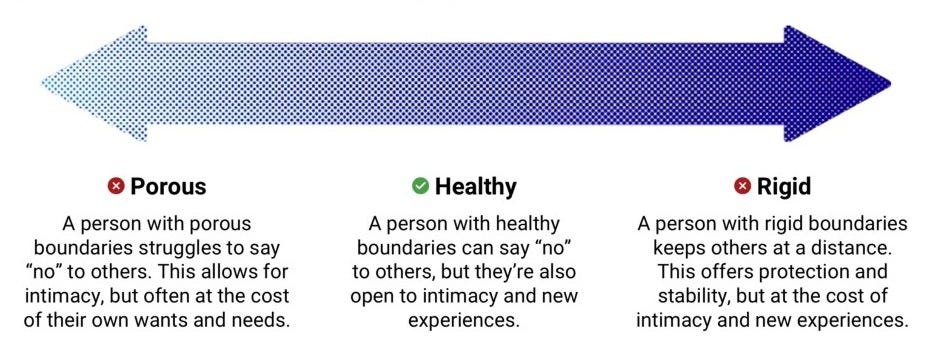
However, boundaries are not rigid rules but flexible and relational. The key idea is that boundaries sit on a spectrum, and health is about balance rather than extremes. See the diagram below:
Some examples of healthy boundaries for this season:
Time: Attending part of an event rather than staying the whole time.
Emotionally: Taking space from heavy conversations to stay regulated.
Topics: Redirecting away from personal or sensitive subjects.
Work: Being less available to work communications over the holidays.
Physical: Choosing alternative greetings if affection feels overwhelming.
Digital: Limiting your own time on certain group chats.
Respect: Pausing or changing the topic to keep things calm.
Each one helps you reclaim a bit of energy that chronic stress would otherwise consume.
This Week’s Challenge: One Honest No
Your challenge this week is simple but powerful:
Say one honest “no.”
It could be:
Declining an invitation you don’t have energy for.
Saying no to an extra task when your plate is already full.
Turning down a screen or scroll session and going for a short walk instead.
When you do it, pause and notice:
What comes up: guilt, relief, fear?
How does your body respond afterwards?
Did the world fall apart when you said no? (Probably not.)
Final Thoughts
Boundaries don’t push people away; they help us show up more fully. By saying “no” to what drains you, you create room to say “yes” to what matters. Stress often builds quietly through endless small acquiescences, the “slow boil” of compliance. But every boundary you set lowers the temperature a little.
During this season, which brings a fruit salad of interesting dynamics and emotions, try to reframe these challenges as an opportunity to practice what you may have learnt from past articles and test some new boundaries.
All being said, we truly value your readership and want to wish you all a very Happy Christmas!!
Resources to Explore
The Book of Boundaries – Melissa Urban
Set Boundaries, Find Peace – Nedra Glover Tawwab
Psychology Today – “Why Boundaries Are Essential for Wellbeing”
Comments from Us
We’d love to hear how it goes — what happened when you said “no”?
Send your reflections to mentalhelperwwc@gmail.com — we might share one (with permission) in a future issue.